
Trust precedes contact
Voice, presentation, service clarity, and transparent expectations work together to help a prospective client decide whether the practice may be an appropriate fit.
Work 01 / Boutique Law Firm Website
Concept ProjectA refined digital concept for a boutique law firm, balancing quiet authority, human reassurance, and a clear path from an important legal question to a considered consultation.
Explore the website concept ↗Independent Trexiti concept for a fictional boutique law firm. Smith & Co. Law is not presented as a real practice, commissioned client, or provider of legal services; all names, copy, services, and interface details are illustrative.
Overview
Smith & Co. Law is a concept for a modern boutique legal practice whose digital presence needs to feel composed, capable, and personal. The experience pairs an editorial visual language with direct explanations of how a prospective client could understand the firm, its focus, and the next step.
The concept treats trust as a product of structure as much as aesthetics: restrained typography, clear content boundaries, careful language, and a consultation pathway that sets expectations without presenting a form submission as legal advice or an established attorney-client relationship.
The challenge
A law-firm website must communicate authority without becoming distant, and warmth without weakening professional credibility. People may arrive during consequential or stressful moments, so the experience needs to make information easy to assess without relying on aggressive promises or generic legal imagery.
The digital journey also needs responsible boundaries around confidentiality, conflicts, jurisdiction, and the point at which a professional relationship may begin. Those requirements cannot be solved by visual polish alone and would need to be defined with the firm before launch.
Understanding the business
Trexiti would begin by mapping the practice model, ideal matters, enquiry risks, decision journey, and the information a prospective client needs before deciding whether to request a consultation.
Voice, presentation, service clarity, and transparent expectations work together to help a prospective client decide whether the practice may be an appropriate fit.
The experience should acknowledge the human context of a matter while avoiding assumptions, guarantees, or language that turns reassurance into an outcome claim.
A consultation request should collect only appropriate preliminary information, explain confidentiality limits, and support a deliberate conflict-check and follow-up process.
System / Experience strategy
Use precise language, strong hierarchy, and considered restraint instead of visual clichés, inflated claims, or unnecessary complexity.
Make the experience approachable while keeping disclaimers, expectations, and the limits of online communication visible and understandable.
Help each visitor understand the practice, assess possible fit, and choose an appropriate next step without pressure.
Architecture
The proposed website separates editorial positioning, practice information, professional perspective, and consultation intake while joining them in one calm, coherent journey.
A distinctive arrival, point of view, firm introduction, and visual system designed to express composure, confidence, and personal attention.
Structured explanations of focus areas, approach, common questions, process, and jurisdiction-specific information for prospective clients.
A measured sequence from initial interest to preliminary context, disclosures, conflict checking, and a human response from the practice.
Content ownership, accessibility, privacy, security, retention, disclaimers, and approved publishing workflows appropriate to the firm and jurisdiction.
The architecture translates the operating model into explicit product boundaries, shared data, and managed connections.
Core features
A confident opening that establishes the practice’s character and value without relying on unverified superlatives or outcome promises.
Plain-language pathways that explain the types of issues the firm may consider and help visitors identify a relevant starting point.
A flexible structure for an approved biography, working philosophy, professional background, and credentials supplied and verified by the firm.
A governed publishing space for educational perspectives, updates, and frequently asked questions with appropriate legal context.
A low-friction request flow that explains what to share, what not to send, what happens next, and that submission alone does not create an attorney-client relationship.
Clear options for reaching the practice, with responsive layouts, readable contrast, keyboard support, and understandable status feedback.
Interface gallery
Screenshots taken directly from the built website concept. The firm and its content are fictional.
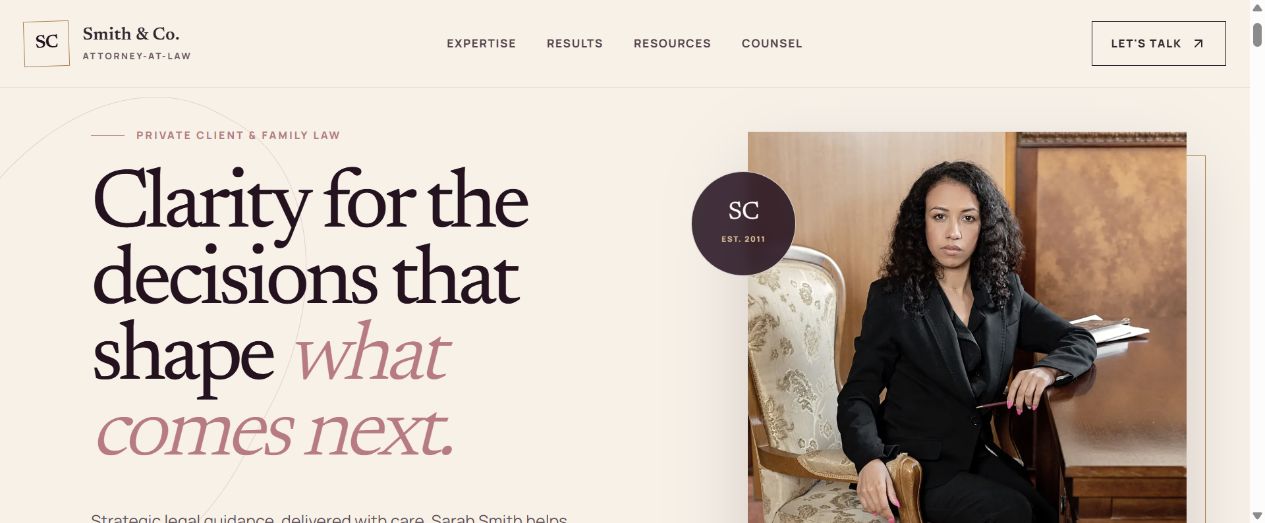
An editorial landing experience that combines quiet confidence, a clear point of view, and immediate routes into the practice.
Actual website concept / desktop introduction.
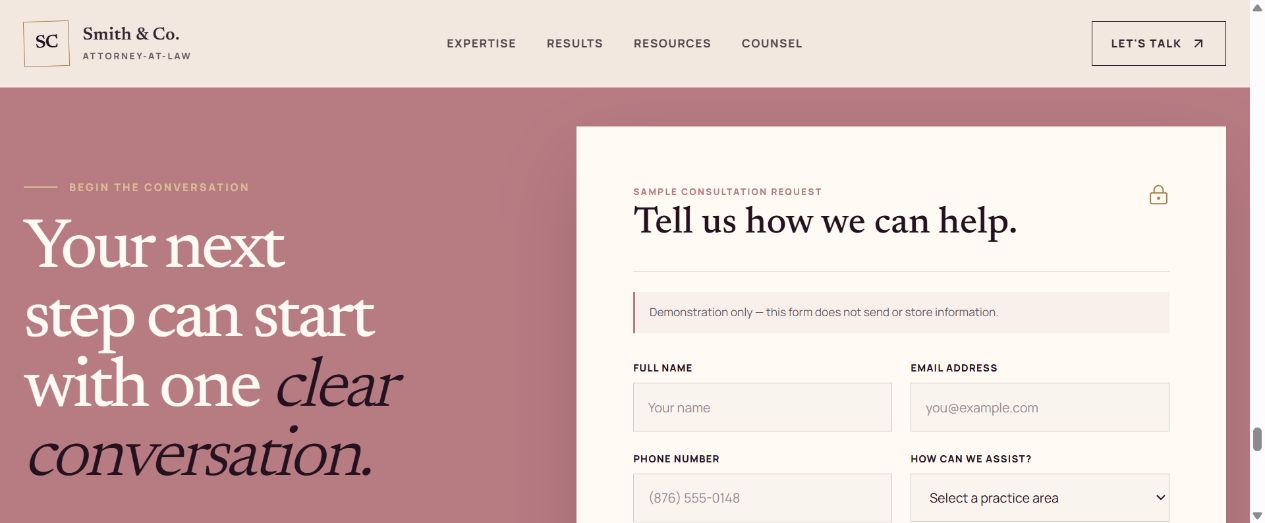
A staged request experience that gathers preliminary context, presents important boundaries, and prepares a responsible follow-up.
Actual website concept / consultation section. Demonstration content.
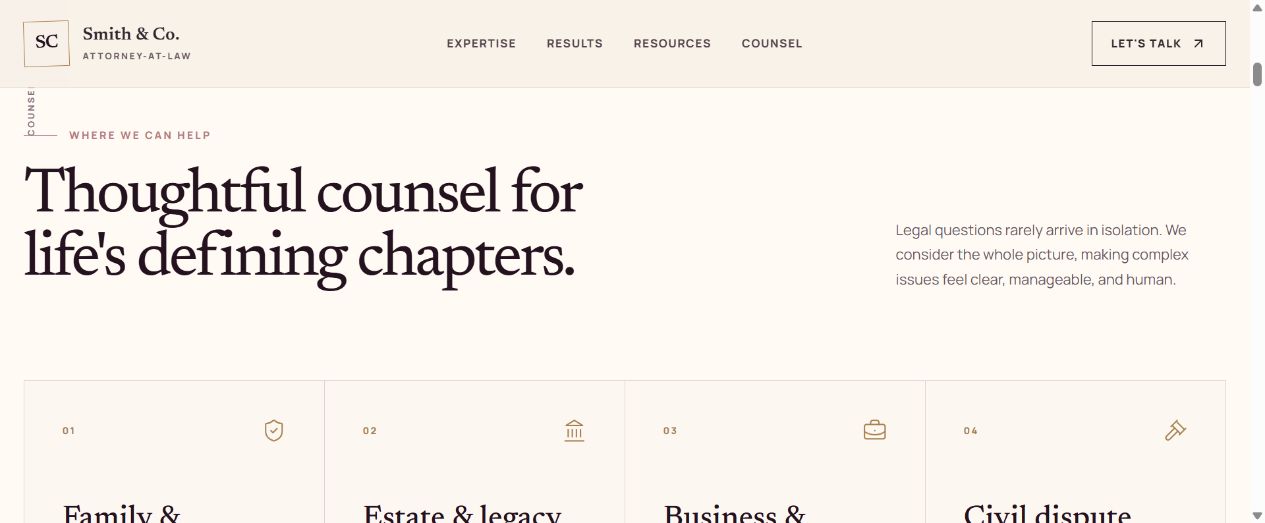
A structured view of focus, approach, relevant guidance, and the next appropriate contact action.
Actual website concept / practice-area exploration.
Engineering
The proposed build would use a responsive, component-driven frontend and governed content structure so the practice can maintain focus areas, insights, biographies, disclaimers, and contact information without weakening consistency.
Consultation intake would require jurisdiction-specific review before implementation, including decisions about data minimization, confidentiality language, conflict checking, retention, secure delivery, accessibility, and who may access or respond to a request.
Proposed component-driven responsive frontend
Structured content model for practice information and insights
Accessible navigation, typography, forms, and feedback states
Server-side validation and abuse protection for consultation requests
Data-minimizing intake with explicit disclosures and retention rules
Firm and jurisdiction review required before any production launch
Outcome
The concept establishes a premium but approachable direction for a boutique law firm’s public website, with one coherent system for positioning, practice information, professional perspective, and consultation requests.
It is not a deployed legal website and makes no claim about an attorney’s credentials, services, clients, case results, regulatory compliance, or commercial performance. Production content and workflows would require verification and review by the operating firm and qualified legal stakeholders.
Independent Trexiti concept for a fictional boutique law firm. Smith & Co. Law is not presented as a real practice, commissioned client, or provider of legal services; all names, copy, services, and interface details are illustrative.
Build the next system
Start with the business problem, workflow, or customer experience that has become too important to leave fragmented.
Start a Project